Welcome to the first meeting of our new Manly Wade Wellman appreciation society. After the golden age of the pulps, there are two authors who, for my money, tower head and shoulders above everyone else spilling ink — Fritz Leiber and Wellman. I don’t think either get enough credit and Wellman perhaps doubly so, especially the Silver John stories, which have, infuriatingly, been out of print most of my lifetime. Nonsense. Madness. The short stories at least have been recently reprinted by Valancourt Books (though with a terrible cover — sorry, John’s not a beardo), so this week I want to raise the profile of the novels. There were five, written for Doubleday and published expressly for the Science Fiction Book Club (I believe). There were paperbacks of some (Most? All?I’m not sure) in the mid-‘80s, but they’ve not been reprinted until the 2023 Complete John the Balladeer from Haffner, a pricey two-volume set.
This is the first, The Old Gods Waken (1979), which sees John get involved in a squabble between neighbors that winds up masking a sinister agenda involving druids, messing with ancient powers and, if John’s too late to the rescue, human sacrifice. The Raven Mockers, evil spirits from Cherokee folklore, play a memorable part.
The details, fun though they may be, are secondary to the feel of the thing. John is just so damn likable and pleasant, even with folks who don’t deserve the consideration, like the pair of druid brothers. There isn’t ever a real sense that John can fail, its his very nature to pick out a song on his silver-stringed guitar and find a solution, or a friend who can help out (in this case, a Cherokee medicine man/social scientist). John’s inner goodness just sees him through and that makes these stories both delightful and odd. You get a real sense of Appalachia, of the rhythm of the speech. These aren’t really horror stories, or fantasy (though John is 100% the template for the D&D Bard) but more warm-hearted adventure stories. I can’t even complain about the druids being such comical, one-note villains.
After Dark (1980) is a bit more robust of a story than Old Gods. John plays a few songs at a strange folk music festival and gets himself mixed up in a plot by the shonokins to, in effect, begin an attempt to take over the United States. They’re an odd creation, previously appearing in stories about Wellman’s New York City occultist, John Thunstone. They’re sort of North America’s answer to the Fae or Formori — they claim to have inhabited the continent before humans crossed the Bering straight. They can’t bear the presence of corpses of their own kind, exert control over something similar to Ley lines and live in Gardinels, giant carnivorous plants that camouflage themselves as houses.
Again, the action is sort of vague and low stakes. The shonokins, led by creepily charismatic Brooke Altic (Wellman had a talent for oddball names), want the land a friend of John’s owns and they make several offers to buy it or otherwise convince the owner to leave, before attacking it with magic. But thanks to John’s own Christian folk magic (found in the very real grimoire, The Long-Lost Friend, a copy of which John keeps in his pocket) and the battlefield conversion of a black magic-wielding witch, the good folks of Appalachia win the day.
It’s hard to convey why these bold, broad stroked novels are so good, but they are. Its the characters, they way they chatter about, the cadence of their voices, the unpretentious way they live (Wellman lived in and loved North Carolina for years). It’s also the way they transpose events better suited for fantasy or horror stories into 1960s rural America, and the way that changes the feel of the action. And John. He’s so good. He’s just a lovable guy. Reading these books, you know you’ve got a friend in him, especially if you ever run afoul of witches and warlocks.
Cover by Michael Flanagan — I love how designy this one is.
Hehe, The Lost and the Lurking (1981) sees John square off against a village full of full-on Satanists, at the behest of the United States government. As ever, all he’s got is a smile, his guitar and The Long-Lost Friend (I’ve included a photo of the title page of my 19th century pocket edition, as it figures into the plot, and it is probably the same thing Wellman envisioned John carrying, which is why I bought it!). The Satanists, led by the beautiful (and pretentious) high priestess Tiphaine never really stood a chance (like the Druids in Old Gods, they are kind of flat as villains, which is interesting — I never really feel Wellman’s villains are all that sexy or alluring). There is a scene early on where the satanic blacksmith gets into a fist fight with John and John wins easily, despite the smith having a charm guaranteeing his victory. Wellman never explains this turn of events, and even John spends the bulk of the book perplexed over it. It’s great, even if it probably a symptom of the speed at which Wellman wrote these novels. Again, though, I don’t think they’re really meant to hang together in a conventional sense, with all the loose ends tied off. They end abruptly, like dreams, and I think there is intention there.
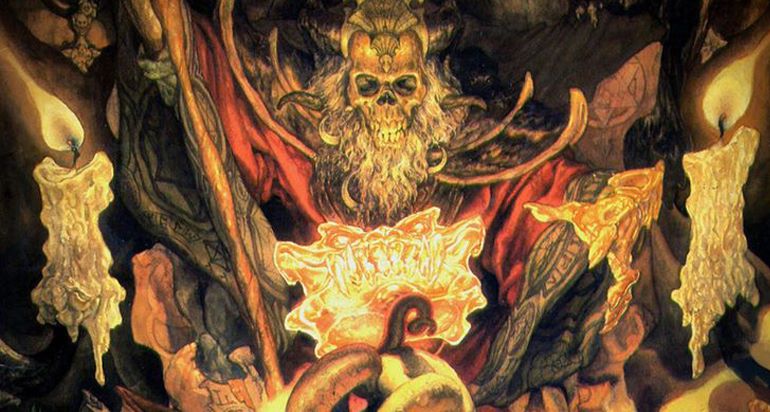
I would be remiss if I didn’t mention the cover art. This one is by Margo Herr and it captures a lot of the atmosphere of the book — the swamps, the fires, the looming presence of the devil, the searching, suspicious eyes looking everywhere. I find all the covers in the series, including those for the two John Thunstone novels Wellman also delivered, very, very evocative. They are all far better than the later, more realistic covers on the paperbacks and the modern editions. which almost always feature a John who looks all wrong.
The Hanging Stones (1982) is a wild one, in part because it vibrating on the same frequency as Halloween III, believe it or not, which came out the same year. It’s probably my favorite of the Silver John novels.
So, rich asshole Noel Kottler is building a replica of Stonehenge on Teatray Mountain to serve as a tourist destination for New Age types (Wellman has two head honchos of crackpot mystical organizations on-site to mercilessly mock the entire novel). Kottler is entirely awful, thinks because he has money he can do anything, buy anything and have anyone do his bidding, including John and his wife, Evadare. John immediately loathes him. It is pretty clear the Wellman does too, which makes for some delightfully snide asides.
As if that weren’t enough, the construction project is being carried out on land that is sacred to a local tribe of ectoplasmic werewolves (the don’t change into wolves, they don a wolf-form of ectoplasm summoned by their heightened emotional state, and you can beat it out of them, which is weird but also pretty great) who try to drive John away and eventually kidnap Evadare to leverage his departure (in order to leave the camp unprotected when they eventually attack). Also there is Esdras Hogue, a wandering sorcerer, who does not like the new Stonehenge, nor the werewolves. Also, Wellman’s NYC occult detective Judge Pursuivant, an old man with a magic sword, shows up as well. It all comes down to a big siege by the werewolves versus the unlikely allies at the construction site, who win out because Hogue summons the spirits of the Stone Age builders/protectors of the real Stonehenge to fight on their side. The only person who dies is the millionaire. Boo-hoo.
The Voice of the Mountain (1984) is the final Silver John novel (Wellman planned one more, but ill health made the writing of it impossible) and its a good one to end on, even it if isn’t the best in the series, nor does it feel like a culmination. In fact, it seems unmoored from the admittedly loose chronology of the books, taking place both late in John’s career (the short stories seem to have all occurred, and his reputation precedes him, yet there is no mention of his beloved Evadare, despite the direction of John’s affections being central to the plot). It’s more like a summation, with all the pieces of the Silver John formula polished and fashioned into their most perfect state.
John climbs Cry Mountain in order to find out why it sobs in high wind (and why it has such a dire reputation). At the top, he finds the enchanted fortress of Ruel Harpe, a sorcerer whose supernatural power is only outstripped by his infuriatingly self-assured ego. There are witches, attempted seductions, a pull cord that steals anything the tugger desires including steaks right off the restaurant skillet, a magic mirror, monsters (the Behinder is once again a memorable unseen presence). Ruel wants John to help him conquer the world. John doesn’t want to help. Fighting ensues and John’s good nature triumphs pretty handily.
Ruel is, for my money, the most interesting of John’s villains save for Shull Cobart and their lengthy cohabitation allows Wellman to draw pretty clear philosophical contrasts between the two. They don’t really hew the way you might expect, even in light of the whole series thus far cutting against the stereotypical city slicker vs. hillbilly narrative. John’s got religion and country ways and a love of song, but its really just the fact that he’s content with his life that allows him to triumph over Ruel and that long line of grasping, scheming wizards. John’s a country boy, but he’s happy in his own skin everywhere he goes. I’m gonna miss him.
As I mentioned, I went to GenCon 2024. The show was interesting, and we recorded a podcast about my impressions. That should come out Monday. This, though, is the story of how I got home.
I stayed in a shitty hotel by the airport (for some reason, my first inclination is to call the airport “plane place,” which made for some bizarre conversational turns at the show). The room itself seemed somewhat unreal. I used to play a lot of Rainbow 6 Siege, and the environments for that game resemble places humans might inhabit – there is the House level and the Department Store level and the Office level and so on. But when you spend time in those spaces not running around shooting things, you realize that they only look like human spaces. They don’t just lack the functionality you would expect, they are so tuned to providing cover and bottlenecks that make for satisfying gameplay that they thwart their mundane purpose. This is true of my hotel room. There was no closet, no safe, no iron, no overhead lighting. The office chair that accompanied the “desk” proved impossible to sit in. There was, aside of the floor, no place to put my suitcase.
The air conditioning unit was dying. It cooled well enough, but it couldn’t commit to being on or off. It would come on with a loud thunk, run accompanied but an almost sub-sonic whine, then rattle off. Initially the intervals were about 20 to 30 minutes, but by the end of the con, it was on and off for five minutes a stretch. On Saturday night, coupled with the noise in the parking lot, the noise from the nearby highway and the noise of loud movies from the room below me, sleep proved elusive.
Oh, I forgot the crickets. Saturday evening, my room was beset by a plague of crickets. Well, four crickets. That’s enough to be a plague, right? So, I am not a vegetarian or anything, but I am really loathe to kill…just about anything. Mosquitos, silver fish, house centipedes, those I can murder. I…could not raise the boot to the crickets. But I did not want them hopping around my room and I certainly did not want them getting packed in my luggage. I put the plastic water cups on top of them. This proved an effective prison, but I had nothing to slide under the cup in order to transport them back outside. So, there they sat. Occasionally, they would hop into the side of the cup, which proved heavy enough for them not to knock over; it did, however, make a little pop noise. Like pop-corn. Pop, pop, pop, pop, all night.
At 6AM, I gave up, got dressed, knocked over the cups, checked out, called my Uber and went to the airport, arriving 2.5 hours before my flight. It took six minutes to go through security and get to my gate, where a little café was serving breakfast. At 8:23, a handful of minutes before boarding, my flight was cancelled. Not delayed. Cancelled. United immediately put me on the same flight the next day. But the plane was literally at the gate! What happened?
A couple with an infant groaned, “Oh no, not again!” Another man stalked off in a rage, shouting, “This is the second time!” There were thunderstorms predicted for the afternoon in New Jersey, which I figured was the cause, but there was no one to ask, at least for 20 or so minutes. Three loud guys sitting in the nearby chairs gave a running commentary on their contingency plan. They had trouble getting rooms because of the convention, but eventually found one for $600 (!). They had no luck finding a rental car. By this time, my thumb was hovering over the “Book your Ticket” button on the Greyhound bus website.
Finally, a United gate agent appeared. I asked what was going on. She explained that the tower in Philadelphia didn’t have adequate staff. But we’re flying to Newark, I countered. She said that Newark’s air traffic control had, until recently, been run out of Long Island, but that it had recently moved to Philly and in the wake of that, there had been staffing issues and cancellations.
Flashback to the delay on my flight to Indianapolis. I was sitting at the gate, listening to two pilots gossip about this very thing. The move was made in order to clear out the older staff that got paid more, speculated one pilot. There was much discussion about how they and other flight staff were meant to get to the airports they needed to be. Apparently, if you’re a stranded member of a flight team, you can always hop on a FedEx plane?
Anyway. I asked the gate agent if this was likely to happen again the next morning, or if I should take the bus home and without hesitation, she told me to take the bus. I bought the tickets. Departure was at 3:30pm. It was currently 9am. I went down to the baggage claim and waited there for five hours. It was cold. I was so tired I couldn’t read. I mostly paced. At one point, I noticed a sign that said “Tornado Shelter” and asked a nearby ground crew member what that consisted of. A hallway, it turns out. You don’t want to be near all the plate glass windows in the baggage area if a tornado is coming through. I explained I was from NJ, so I didn’t know anything about Tornado. He was from NJ, too, Plainfield originally. His son was currently stuck in Newark trying to get to Indianapolis and his aunt, the week before, resorted to taking the bus from Newark to Atlanta when her flight was cancelled. “They shit’s all fucked up,” he assured me.
I called my Uber at 2pm. It was very spacious and comfortable. I asked my driver how much he thought Uber would charge me to drive to NJ and he speculated $1,500. He then told me a story about driving a stranded rich guy from Indianapolis to Louisville under the table for a couple hundred dollars plus tip. I took the bait and asked how much he would charge me to drive the 12 hours to NJ. He thought about it a long time and said $800. Ladies and gentlemen, I considered if for the rest of the ride.
Speaking of places hostile to humans, the Indianapolis Greyhound terminal was about on par for a bus station, which are basically glorified parking lots. This one had chairs, which is more than I can say for Manhattan’s. The woman who ran things (Danielle) was both extremely tough and extremely nice (to me, at least). She explained the process (line up at aisle 4; when the bus comes, throw your big bag in the baggage compartment; take your seat; and if anyone messes with you, see me) and in short order I was on my way home.
The odyssey was 18 and a half hours. We stopped in Dayton, Springfield and Columbus, Ohio, for about a half out each, then did a long haul to Pittsburgh where we changed drivers and sat around for 90 minutes. We arrived there at midnight. None of the vending machines worked, nor did the sinks. The new driver brought an intensity that seemed out of place for the early hours of the morning. He reminded me a lot of Michael Williams’ performance as Omar in The Wire: he talked loudly and suffered no fools, but was very kind to little old ladies. He also drove like a demon, consistently arriving 10 to 20 minutes earlier than planned. From Pittsburgh, we did the longest haul to Harrisburg, then another pretty lengthy trip to King of Prussia, though we made such good time for both that the driver inserted surprise rest stops along the way. I slept a little on the way to Harrisburg. At the stop there, I bought one of those stupid neck pillows. After leaving King of Prussia, we took a turn onto the highway that was so hard that the baggage compartment opened up, spraying luggage across the road that was beginning to fill up with commuter traffic. The driver scrambled out and retrieved everything in what was probably less than five minutes, but felt like hours. The entire bus held its breath while he was out there.
There was a three-car accident directly in front of the entrance to the Philly bus depot. That slowed things down a bit. The bus was originally slated to arrive in Newark a little after 9:30am. The Greyhound app predicted we’d get there at 10:15. Somehow, thanks to the driver’s dogged determination to always be earlier than expected, we pulled in at 9:56, which seems entirely impossible looking back on it. Daisy picked me up a short walk from the bus. Things get really fuzzy after that – turns out sleeping only a handful of hours out of 48 or so is not so easy in your forties. I am writing this four full days later and still feel tired. I feel like I will never not be tired again. But I made it!