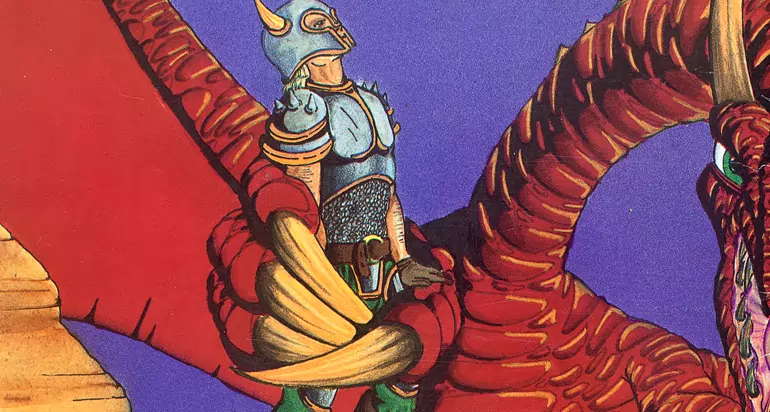
Squares will tell you that the first punk rock band was the Sex Pistols, formed in 1975, but this is hardly a settled matter among punk enthusiasts, who will cite the Ramones, the Saints, Television, the New York Dolls, the Electric Eels, Death, the Stooges, MC5, the Sonics and sundry garage bands stretching ever-further back down the timeline as the true progenitors of the form. When you believe it all started with the Pistols and one of these other acts hits your ears, you can feel the ground shift under your feet. Barony (1990) is kind of like that for TTRPGS.

The folder contains three booklets. The core rules are called Conrad’s Fantasy, though I’ve no idea who Conrad is. In fact, I have a hell of a hard time reading these rules. They’re just…dense and amateurish, full of asides and often just plain unclear. Despite this, I can still see the outline of a completely different kind of “free-style” game for 1990, one focused on storytelling rather than dice rolling and laying out ideas decades ahead of their time. There are no hit points, for instance; rather, characters have a stack of keywords they lose as they take damage (very much like Goblinville, for instance). Skills are checked by rolling 2d8, but there are degrees of success. Weapons aren’t defined, but rather combat tests the way a character uses them. The magic system is free-form, similar to Ars Magica, where players pick a law of reality to break and, anticipating Mage, work to prevent Reality from blowing back on them. Two booklets are devoted to generating games — one for scenarios, the other encounters — using Tarot cards; a third system in the core book uses Tarot to resolve epic combat against dragons (and I can’t help but compare all this Tarot stuff to the recently released His Majesty the Worm).
The result is…curious. It’s strange to read because it seems like 21st century RPGs owe many of their idea to Barony. But like proto-punk, I am not sure that is actually the case — Barony is not often cited and proved damnably difficult to find. Rather, I think these things maybe work in cycles, and that similarly minded designers arrive at the same conclusions sometimes, even if those times are on different points in the timeline. It’s still an amazing read. Er, well, it would have been, at least, if they’d hired an editor.



I found these on DriveThruRPG after reading this blog post, so interested parties can check these out without the difficulties of constantly checking ebay or Noble Knight in the hopes of obtaining a rare copy in the wild. They are pretty pricey for a PDF of an old RPG though at $10 USD a pop (that’s for each of the three individual booklets Stu discusses).
Good catch!