Right, so, yesterday, I talked about how magickal thinking has its own rules, and how those rules lead to conclusions that are A. Internally consistent and B. Different from “rational” thinking. What you get is…maybe something that isn’t real, per se, but feels real, or at least correct. I’m not a believer, so I don’t know exactly what utility that feeling has, but it does seem to have some among the devoted. And the power of the feels is certainly apparent when you move into the realm of fiction, so I know there really is something to it all. And, on some level, I want there to be something to it all, because that means the world is less dreadfully prosaic than it seems to these skeptic’s eyes. That desire is part of the magician’s calculus as well, I think.
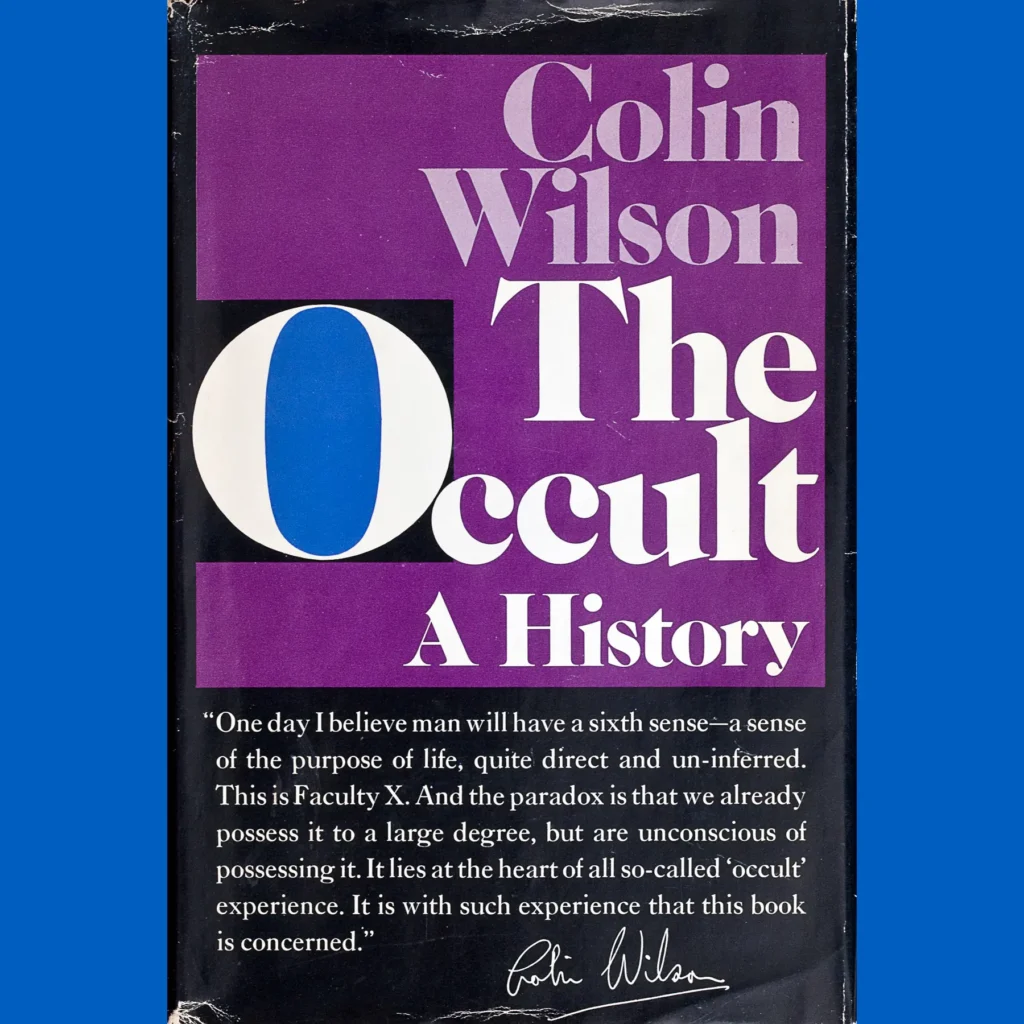
Anyway, Colin Wilson’s The Occult (1971) is sort of a history of esoteric practice, but filtered through Wilson’s theory/fervent desire that the practice is fueled by a latent sixth sense he calls Faculty X. Occultism is the way we awaken and refine Faculty X. The book is fueled primarily by Richard Cavendish’s The Black Arts and Robert Graves’ poetical take comparative religion, The White Goddess (1948, and drawing extensively from Frasier’s The Golden Bough), so you get a firm historical foundation mixed with wild extrapolations of Frasierian wishful thinking.
I love it? I mean, it’s lunacy, I think, and that lunacy probably taints the historical content to a degree (I’ve chased down several of Wilson’s memorable, useful anecdotes only to find they have no basis in fact, or even misunderstanding). But still, it feels right so often, it’s easy to ignore the flaws (at least, it is here; the follow up volumes Mysteries, 1978, and Beyond the Occult, 1988, increasingly test my tolerance). Or rather, perhaps, I can allow Wilson to change the way I think about the occult, without having to accept Wilson’s more crankish theories.
