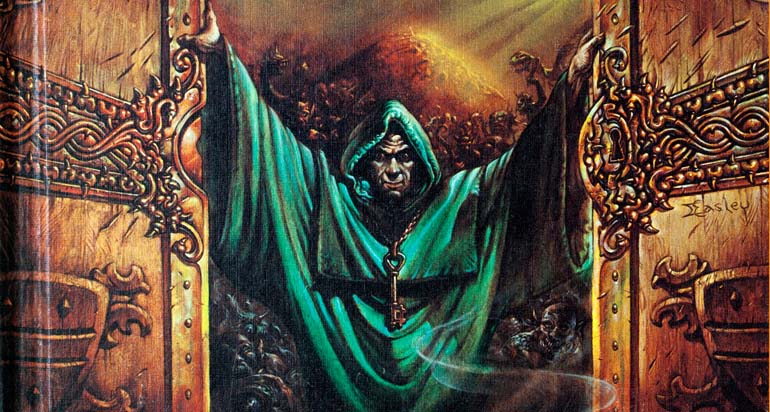
Much as I like the David C. Sutherland cover of the original Dungeon Masters Guide, and much as tend to find Easley’s art fairly generic, I favor this cover. While the original maintains sense of mystery and that certain forbidden quality the early books tend to conjure up, I think this fellow, with his key and his ominous doors is an apt visual metaphor for the role of the Dungeon Master.
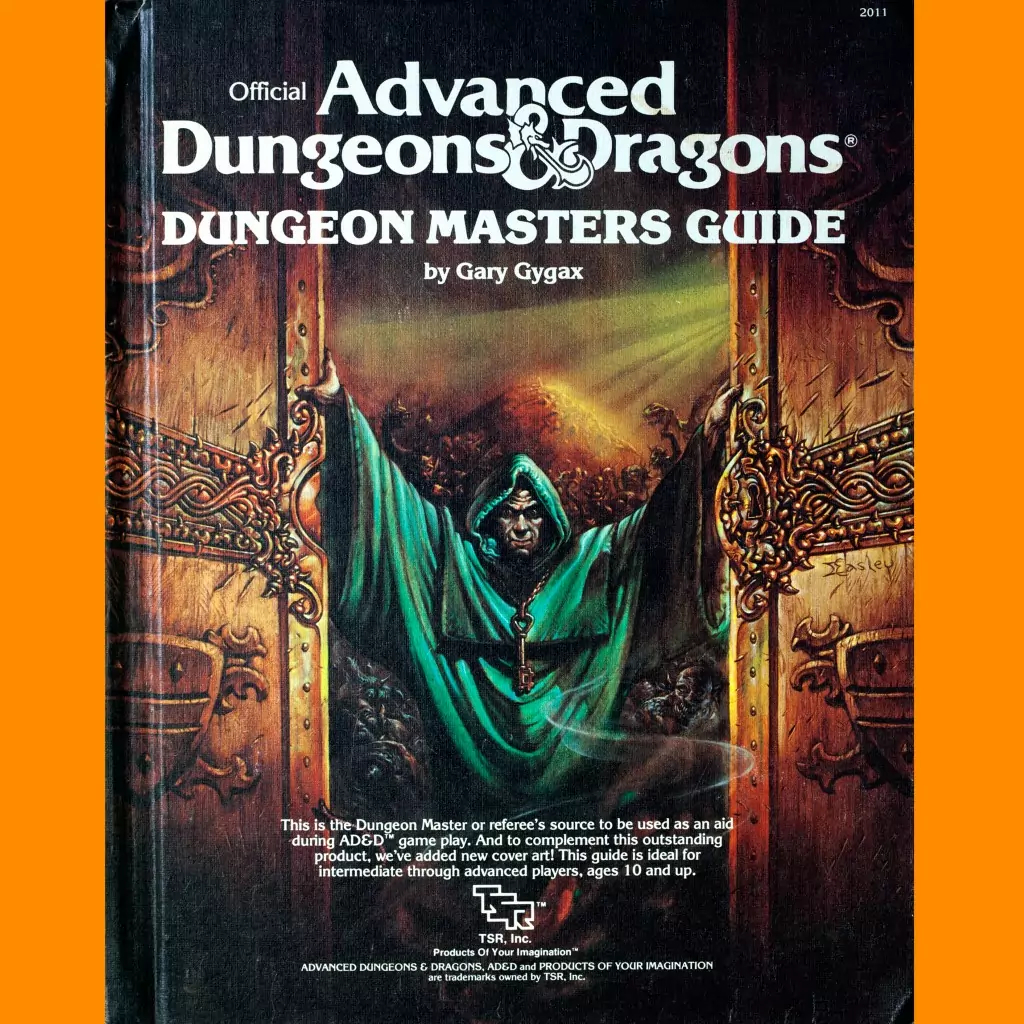
Big miss: they still didn’t put the apostrophe in to make Master possessive.
Still, if you’re looking for the flash point of the edition wars, the orange spines are it (even though they aren’t, you know, a new edition). You don’t have to go far around the table to find someone who will argue that that orange spine books lost that “old school” vibe, that they marked the start of TSR’s shift from hobbyists to exploitative publishers, that somehow this marks a fundamental shift from what D&D was supposed to be, as if there is some correct way to play a game of make-believe. If you’ve been following me for a while, you’ll be entirely unsurprised that I find such arguments tiresome. Nevertheless, here is where they were born.
Here’s something actually annoying about the orange spine editions: they’re cheaper than the original bindings and have a habit of pealing down the spine like a banana. Some titles seem more prone to it than others (Unearthed Arcana and Oriental Adventures seem disproportionately afflicted), but I’ve seen it happen to all of them including my original (and much lamented) copy of the Monster Manual. Thus, the orange spines also mark the beginning of a long tradition of creatively taping up your D&D books.

In the 80s there was still a general understand of basic punctuation…. right?!? The obvious lack of an apostrophe is so odd to me. Or are they saying there can be many masters? It still reads weird