
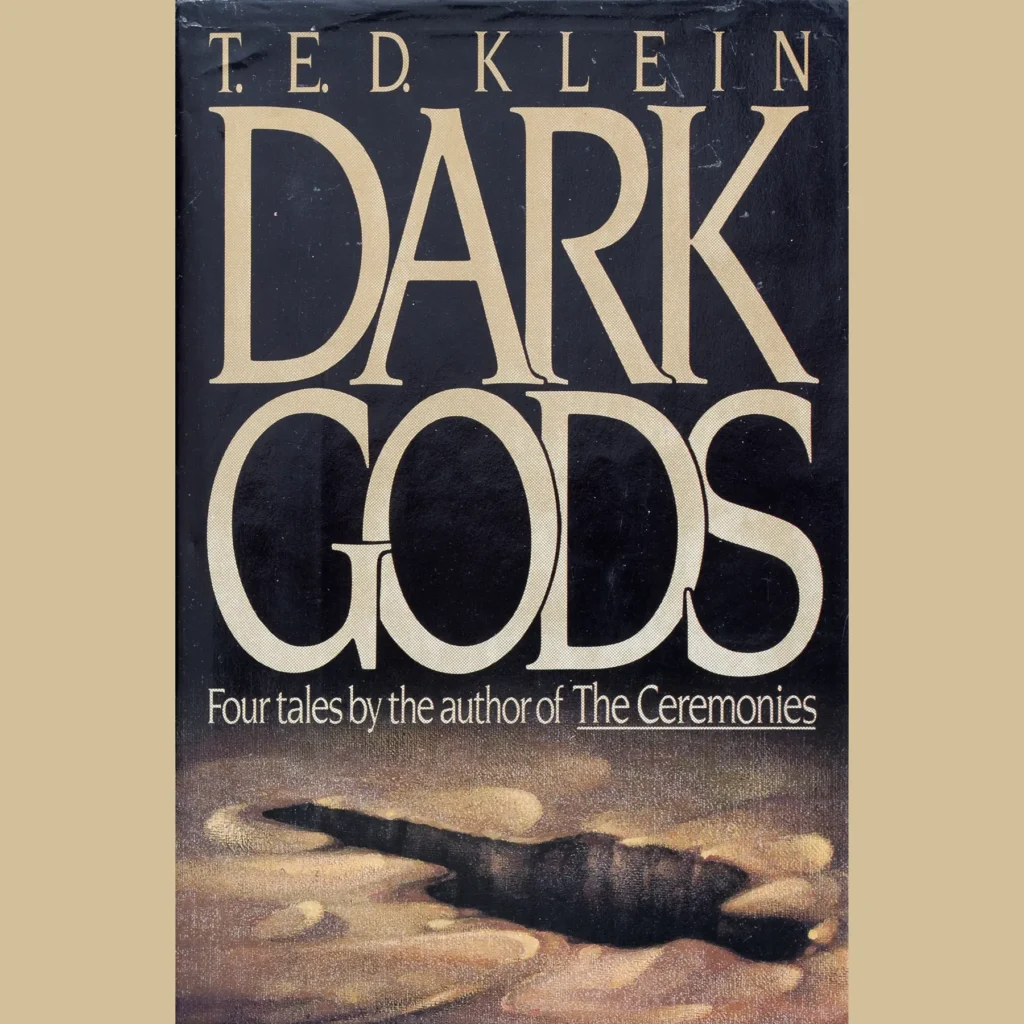
Dark Gods (1985) is a large part of T.E.D. Klein’s rather small body of work — the rest consists of the novel The Ceremonies, which is an expansion of the short story “Events at Poroth Farm,” a collection of shockingly mediocre short stories called Reassuring Tales (2006)and collection of essays, Providence After Dark (2019), in which he goes full Boomer. If you stick to the 20th century stuff, though, you’re in for a treat. Especially this volume.
Before we go on, though, I want to note that two of these novellas, “Black Man with a Horn” and “Children of the Kingdom” tackle racism in varying degrees, mostly focusing on the idea of white fear of the Other. For some folks, the division between the characters being racists and the author being a racist is unclear. I don’t really agree with that; I think Klein is obviously positioning his narrators as being wrong-headed, but I also don’t think the way Klein goes about it would be regarded as acceptable if they were written today — it’s more than possible to portray racist characters without perpetuating racist tropes and language. I don’t love using the “for their time” argument, but, well, I think we ought to give these stories a little room.
Anyway, there are four novellas here. “Children of the Kingdom” concerns the supposed machinations of horrible things living underneath Manhattan. “Petey” is about a cocktail party and how it ends. “Black Man with a Horn” is about a mediocre writer of Lovecraftian pastiche getting caught in a Lovecraftian pastiche. Finally, “Nadelman’s God,” which won a World Fantasy Award, tells the story of an ad man discovering the far-reaching consequences of writing bad poetry.
To say more about the individual plots is to spoil them. I’m not one for spoiler warnings, but Klein’s real talent is putting his straightforward, unadorned style to the task of slowly building dread, usually amidst an array of seemingly mundane social situations. I would say, though, that his use of the urban environment is groundbreaking (only Fritz Leiber in Our Lady of Darkness really beats him to the punch) with the concept of the “City,” or its shadow, looming large in all the stories. More than anything, though, I think Klein is the first iron clad proof that “Cosmic Horror,” so long tied to the views and stylings of Lovecraft, actually has varied applications. His whole corpus is Cosmic, without being terribly Lovecraftian (even the pastiche), and in demonstrating that possibility, he opened the door for other, later writers to go even further abroad.
