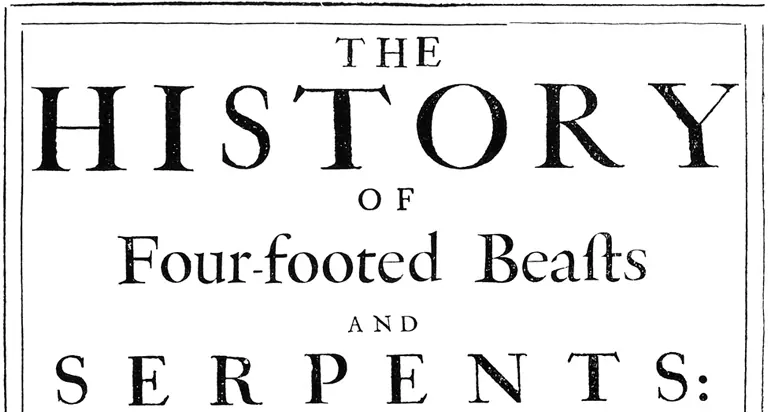
Not a grimoire, and honestly, how could I top Touch Me Not? But, like that book, this is a facsimile of a much older book. When I bought it, actually, I didn’t really know how seriously the word “facsimile” was being deployed, but this is indeed a 1-to-1 recreation of some very hefty books written in Elizabethan English. Which books? That requires some explaining that likely no one will care about but me, but now I don’t have a character limit now, so I can indulge.

Edward Topsell published The History of Four-Footed Beasts in 1607 and followed it with The History of Serpents in 1608. After Topsell’s death in 1625, these two volumes were combined and published as, you guessed it, The History of Four-Footed Beasts and Serpents, in 1658. This is a facsimile of that tome…sort of. For whatever reason, De Capo split Beasts and Serpents into two separate volumes, added a third volume by an entirely different author (The Theater of Insects, by Thomas Muffet) and titled the facsimile The History of Four-Footed Beasts and Serpents and Insects (1967). It is, well, Topsell’s bits are, essentially a translation and expansion of a portion of Conrad Gessner’s bird-obsessed Historiae Animalium (1551), which is basically a rework of Aristotle’s book of the same name from the fourth century BCE. All three are massive attempts to catalog the animal kingdom that also accidentally sweep up some legendary beasts along the way. It’s worth noting that Topsell himself was a bit of a ding-dong who is often simultaneously dismissive and incredibly credulous.
This book is, to my knowledge, the first instance of my favorite manticore illustration, and one of the longest entries on the creature anywhere in pre-modern English (no telling where the illustration is from; Topsell used many of Gessner’s, who also lifted from other sources). The Su is here, as is Lamia and the Gulon and the Libyan Gorgon and a very mean looking beaver. Probably dozens more — the book is 586 densely packed pages. The serpents volume, predictably, is as interested in dragons as it is snakes (and dear god, even real snakes look monstrous in Topsell’s lens — check out that hideous boa!). This is real foundational monster stuff — Gary Gygax almost certainly had either this or an abridged version called An Elizabethan Zoo that had been floating around since 1926, which would in part explain why the D&D Gorgon is not a snake lady.
For the true monster aficionado. There are POD version available now, but they actually cost about as much as this De Capo edition, and this one is pretty nice. Seeing the manticore in full A4 glory is **chef’s kiss**


