
Tim Hutchings’ Thousand Year Old Vampire (2019) sure raises the bar for journaling solo RPGs to new heights.
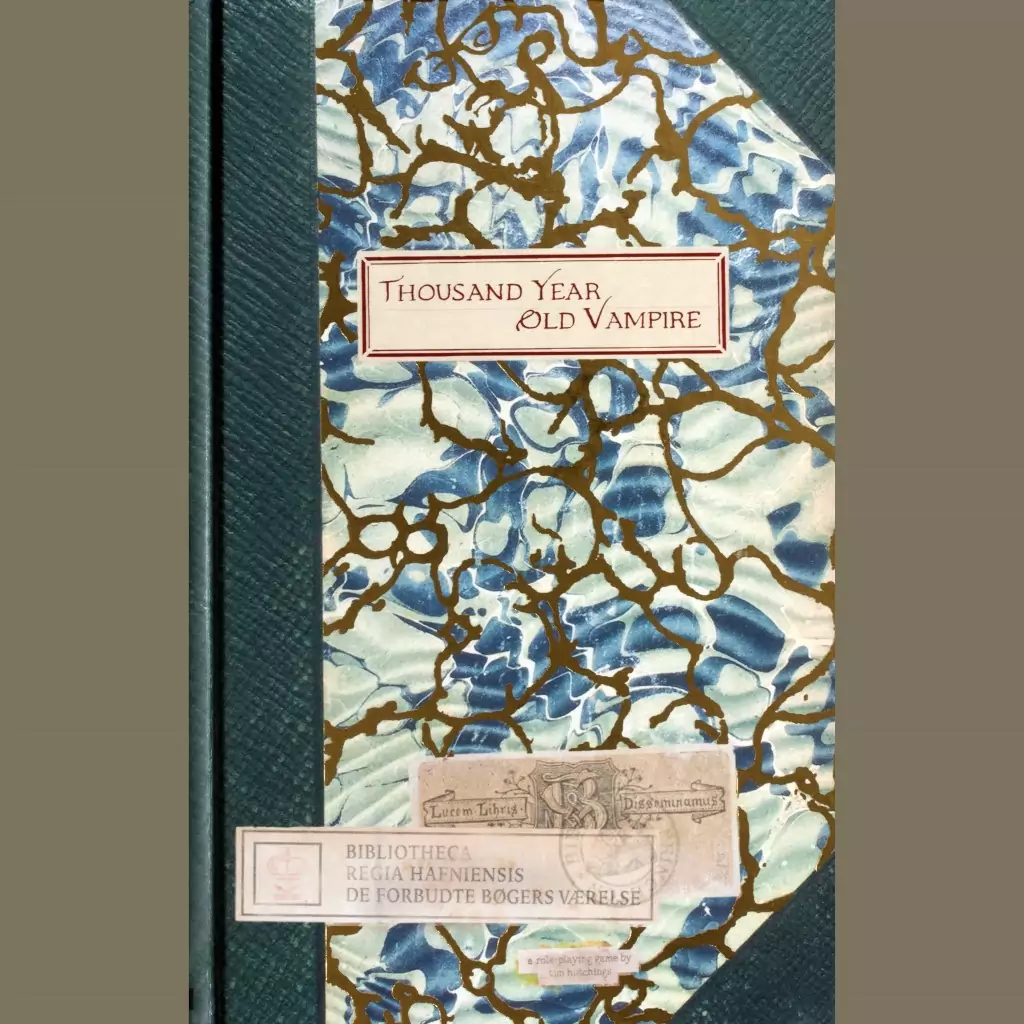
A vampire is a collection of keywords. These are skills, resources, characters (who regularly die of old age) and marks (physical manifestations of the curse). Most of all, though, vampires have memories. They have space for five, each made of three experiences (in practical terms, experiences are single sentences that, when collected, describe one thing of importance). Once those spaces are full, they can offload up to four memories into a diary.
All these things are at the mercy of the numbered prompts. You start at number one and then use dice to navigate your way through the rest — you subtract the result of a six-sided die from the result of a ten-sided die; a positive results moves that many entries forward, a negative result moves back. Mostly the prompts tell you something, then ask you a question about it. Answering that question creates an experience, which you must log. Sometimes prompts give things, like keywords — the first prompt burdens you with the skill “bloodthirsty.” More often they take, instructing you to kill characters, use skills, abandon resources. After a little while, even when the prompts give, they take away. If every prompt creates an experience, you’ll soon be full up of memories. At that point, you have to choose what to forget.
Crossing out memories is an unexpected agony. Surrendering to the prompts is necessary for the flow of the game, but when you’ve made it through a chapter only to start chipping away at the memories, it sometimes feels like the game asks too much. Worse: when it’s all at once. Fate can rob you of your diary and, with it, all the memories it contains. A loss of that magnitude feels like, well, being stabbed in the heart. When you’re all out of keywords and memories, the game is over and your vampire’s ultimate fate is revealed. Most often it’s some flavor of oblivion, and it is always a relief.


One thought on “Thousand Year Old Vampire (2019)”