When I was working on Monsters, Aliens, and Holes in the Ground, I initially thought I was going to focus a lot of my effort on interviews. There were a couple reasons for this, but the main one was that it seemed important to get still-living designers on the record (and it is!). But another reason was, maybe, that it was easier to talk to other people about what they thought of the whole tabletop roleplaying hobby than it was to figure out what I thought about it.
In practice, it was difficult to get people to commit time and energy to talk to me, a guy they didn’t know and had no reason to take seriously when he claimed to be writing a book. And, as I got writing, I found that I did have plenty of my own thoughts about the hobby. You can see this change happen in the book if you pay attention; I wrote it chronologically, so there are a bunch of interviews early on, and then they trickle off. I don’t think any interview material turns up in the 21st century chapters at all.
This is not to say the interviews aren’t interesting. They are! And some day I will perhaps reprint them in their entirely, as I did with Jennell’s. I am right now mostly trying to explain why there are so few of them.
Anyway, there was one question I asked all the designers that I talked to: “Do you think that RPGs were inevitable? If Dungeons & Dragons was never created, for whatever hypothetical reason, do you see yourself or someone else eventually coming up with something along the same lines? Or was D&D a unique catalyst?”
I don’t normally care about hypotheticals, but this one interests me, I think, because the history we wound up with seems somehow…tenuous. There was emphatically not an arms race going on at the time, but a lot of parallel thinking was going on in the early ’70s. No one was trying to beat D&D to shelves, though. But when it came out, a whole new scene exploded around it, instantly, hungry for what was essentially a new game form, almost like they were waiting for it. The D&D rules were difficult to parse, and yet people tinkered them into new forms in scant months, which seems to argue that the game wasn’t as novel as it now seems. But on the other hand, D&D never really lost the first-out-of-the-gate advantage, despite stacks of missteps and disasters, which points to a certain sense of peerlessness. It’s weird.
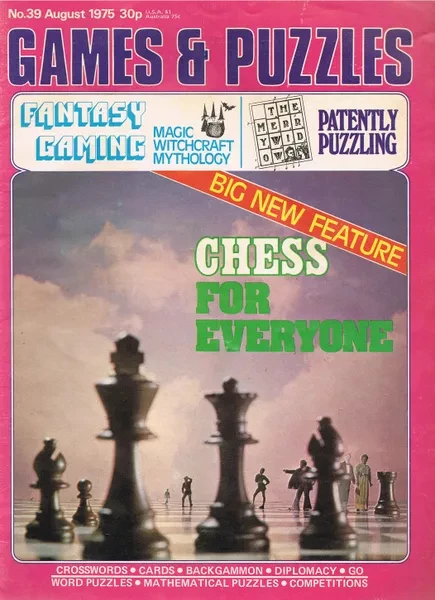
I was reminded of this because John Power (Mr. Wyrd Science) posted an article the other day from Puzzles & Games #39 (August, 1975). “Fantasy Gaming,” by Tony Bath, is, well, interesting! The hobby scene as Bath describes it is much less settled than I expected. Look at how he praises D&D while also not focusing on it for more than a sentence! Look at how he’s already looking for new ways to play, and re-evaluating old ones with fresh eyes. I happened to have spent some time with Aaron Trammell’s The Privilege of Play earlier this week, so Bath’s offhanded remark about model trains seems like a prescient anticipation of Trammell’s use of the MIT Model Railroad Club as the ur-example of networks of privilege in nerd land. And that first paragraph also somewhat confirms my long-held suspicion that early game rules leaned in to complexity in order to distance themselves from accusations of childishness.
Anyway, it got me back on this unanswerable question of inevitability, so I though it was time to dig out those designer quotes and tidy them up (I’ve published some, if not all, of these in Patron newsletter, so apologies if they ring familiar). Perhaps there are new insights to glean from them now.
Ken St. Andre (Tunnels & Trolls, Stormbringer)
D&D was definitely an unique catalyst for creating roleplaying games as we know them, a kind of a spark in the undergrowth that turned into a wildfire sweeping across the countryside. I believe that Dave Arneson and his Blackmoor gamers should be the ones that get the true credit for creating the fantasy RPG field.
Miniature gaming had existed since the 19th century and had never turned into roleplaying. Franchised games based on popular properties have been with us for at least the entire 20th century, but they never turned into roleplaying. […] They might replicate the TV show, the radio program, or the movie, or even a book that spawned them but they were just wargames, racing games, mystery games. Acting is roleplaying, but actors don’t have character sheets with attributes. They don’t roll dice to see how things turn out. Perhaps the closest to actual fantasy roleplaying was Clue, in which the players took on various personas in playing the game, but you hardly ever see players deeply into their characters in Clue. They’re just tokens.
Roleplaying was an idea just waiting for its moment to happen, but someone had to do it first. Once we fans understood the true nature of roleplaying a la D&D there was an explosion of creative ideas, of different, possibly better ways to do it. Me, Greg Stafford. Marc Miller, David Hargrave and a host of others, all with our own visions of what could be done with such a marvelous, basic idea.
Dr. Dennis B. Sustare (Bunnies & Burrows, Swordbearer)
People will always want to put themselves into another character, whether in a novel, at a movie, in a history book, in a superhero comic, or in an RPG. And since there are always people drawn to formalization and quantification, yes, something like RPGs, even the more restrictive definition in Heroic Worlds, was inevitable.
James M. Ward (Deities & Demigods, Gamma World)
Roleplaying has been with us as long as there has been an us. Deep in the caves, natives etched pictures of animals they hunted and imagined hunting them. Kids played cowboys and Indians and took shots at the Indians and something had to be done about if they hit or not. We read comic books and watch movies and imagine ourselves in those roles. It would have happened for sure.
Bill Slavicsek (The Star Wars Sourcebook, Harbinger House)
Yes, I believe RPGs were inevitable. From what I’ve read and heard, Gary and Dave weren’t the only gaming groups beginning to play with the concept around that time, and it’s a natural extrapolation from the wargames that were being played in that period. Also, RPGs have their roots in the games of make-believe we played as children. Eventually, someone would have gotten the idea of providing rules and structure to such activities. Would they have developed as they did without Gary and Dave? Probably not. But I think we would have seen an RPG of some sort before the ’80s were finished. Of course, D&D hit at exactly the right time to inspire the development of computer and videogames. And by using a variation of medieval fantasy and Tolkien, D&D provided a familiar baseline that made it much more acceptable and approachable than any of the niche RPGs that came later. This, I believe, is the reason it has not only survived but thrived as the years have gone on.
James Wallis (The Extraordinary Adventures of Baron Munchausen)
Well, RPGs didn’t start with D&D. In his book Storytelling In The Modern Board Game, Marco Arnaudo talks about Ariosto’s Maze in the 1600s, a roll-and-move board game in which players narrated their character’s adventures. I’m reading a book to my youngest, written and set in the late 1940s, and on a long train journey the family play what’s indisputably a proto-RPG about a wagon-train to California. But of course these weren’t commercial games.
It’s clear that there was a lot happening in the 1960s and 1970s, influences and design traditions from all over the world were coming together and cross-pollinating, the foundations of what would become Eurogames were being laid, and wargames were emerging from their military background into recreational forms. So not only were the threads that made D&D ready to be woven together, but in a spectacularly mixed metaphor there was fertile ground ready for it. There was an audience of people who were ready to take on the challenge of a game like that, culturally as well as stylistically, whereas perhaps ten years earlier, before the influence of 3M games and Avalon Hill, and before Lord of the Rings had spawned the modern fantasy genre, it would never have found a player base.
And I’m fairly sure that if it hadn’t been D&D, another RPG would have emerged that decade (and if we’re playing parallel-universe bookies, my money would be on Chaosium evolving a narrative game out of Glorantha and White Bear and Red Moon). The time was ripe for it, all the influences were in place. Looking at how freeform LARP was invented almost simultaneously in three or four different places around the end of the 1980s – yeah, when the tech-tree of game mechanics reaches a certain point, the next step is going to happen pretty quickly. RPGs were inevitable.
Jennell Jaquays (The Enchanted Wood, Dark Tower)
I’m not sure. Typically, with “inevitable things,” particularly inventions, there are often simultaneous inventions going on. It becomes a matter of who publishes or popularizes things first as to who gains fame or notoriety as the inventor. In this case, you had several wargamers who knew each other creating characters that could be roleplayed as a part of fantasy tabletop wargames. The whole hobby grew as a tree from the seed that Gygax, Arneson and David Wesley planted and tended there in Minnesota and Wisconsin. Every other RPG after that was a response to Dungeons & Dragons.
Would a Ken St. Andre have created Tunnels & Trolls without Dungeons & Dragons paving the way? Probably not. But would someone in the orbit of Greg Stafford and Chaosium have eventually created a fantasy RPG? I think that’s entirely possible. Interest in heroic fantasy was already on the rise in the early and mid-‘70s, otherwise there would not have been Conan the Barbarian or Fafhrd and the Gray Mouser comic books for me to find while in high school. There were other creative minds at work in the mid-‘70s, many who had already been “roleplaying” as the leaders of nations in the game Diplomacy, or being involved as faction leaders in play-by-mail games. It was a child waiting for the right parents to come along and give birth to it.
* * *
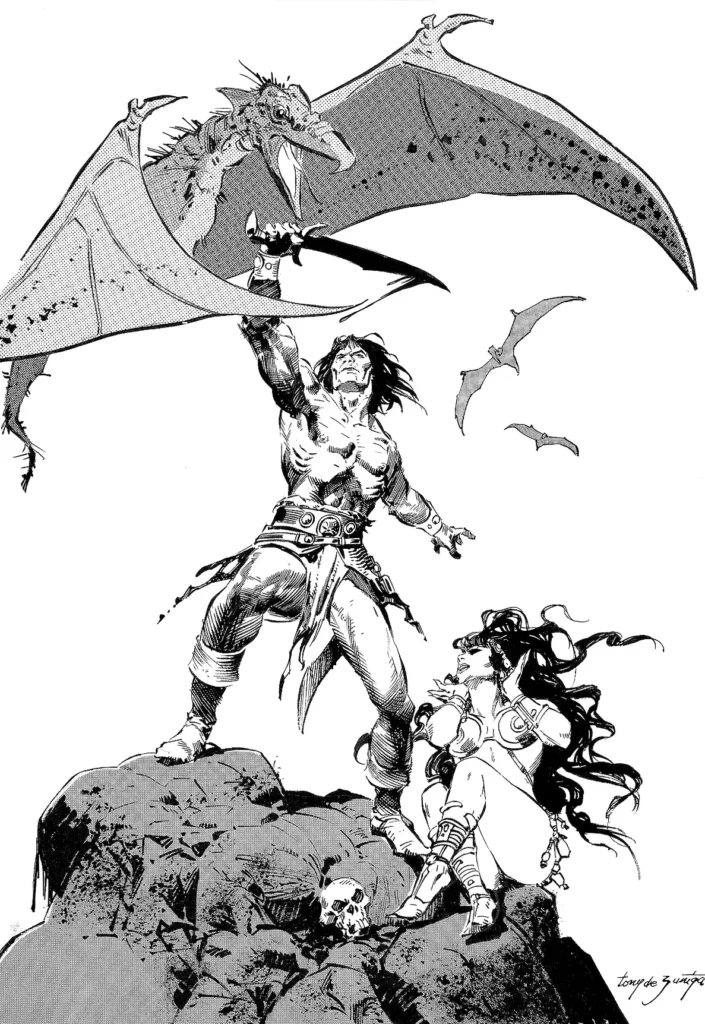
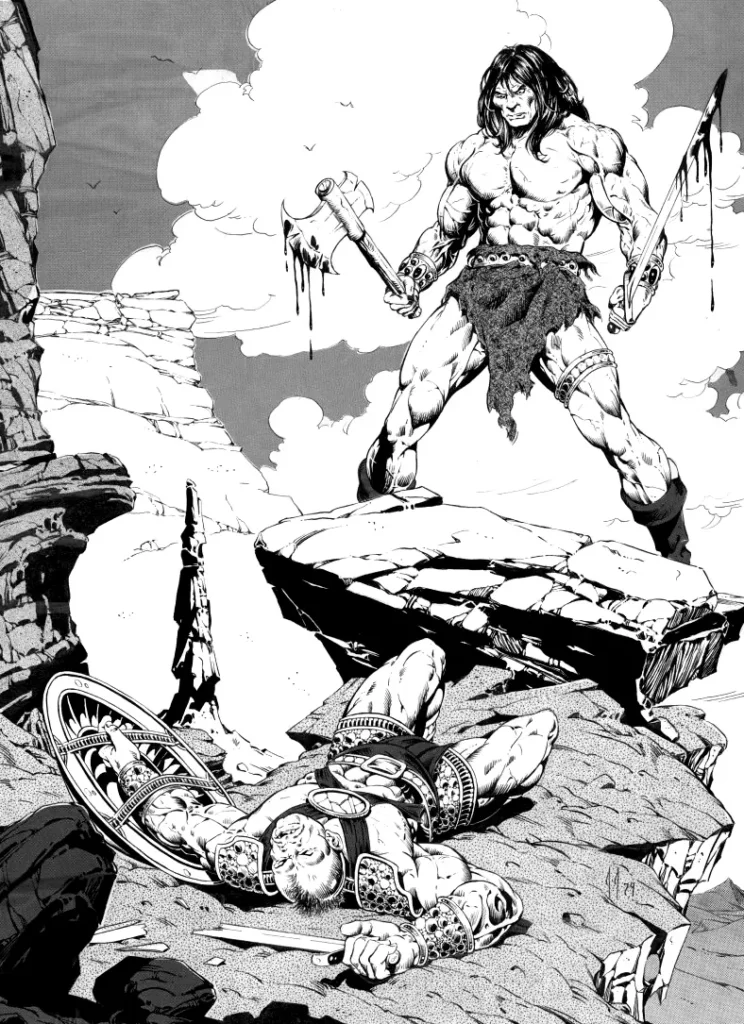
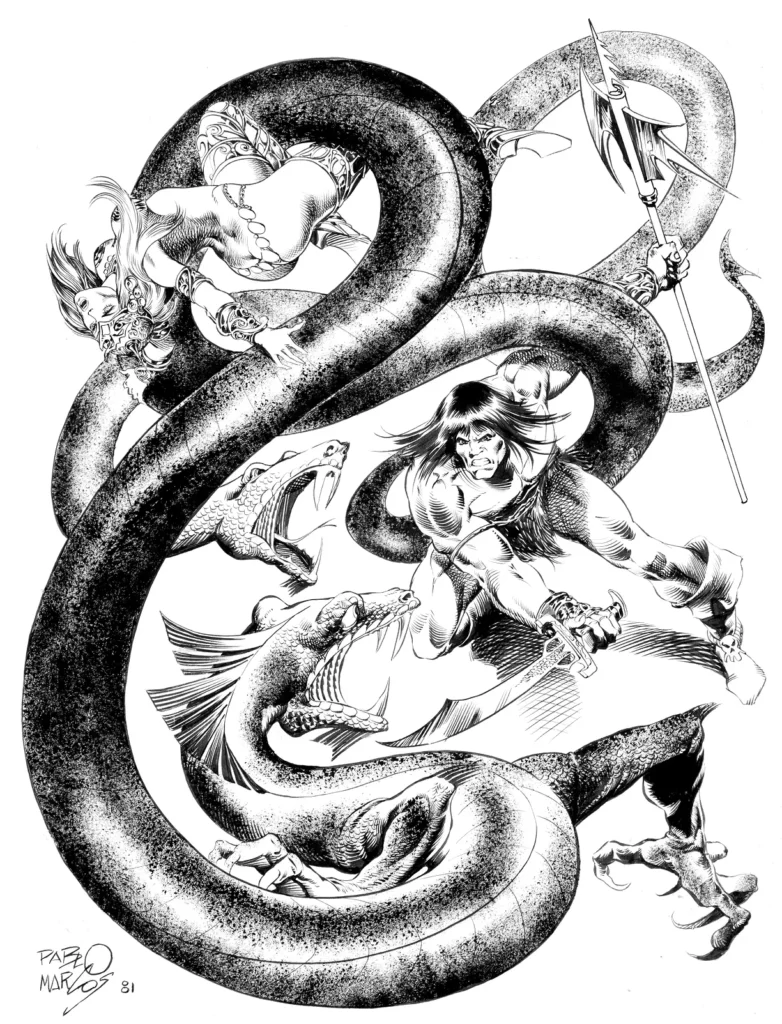
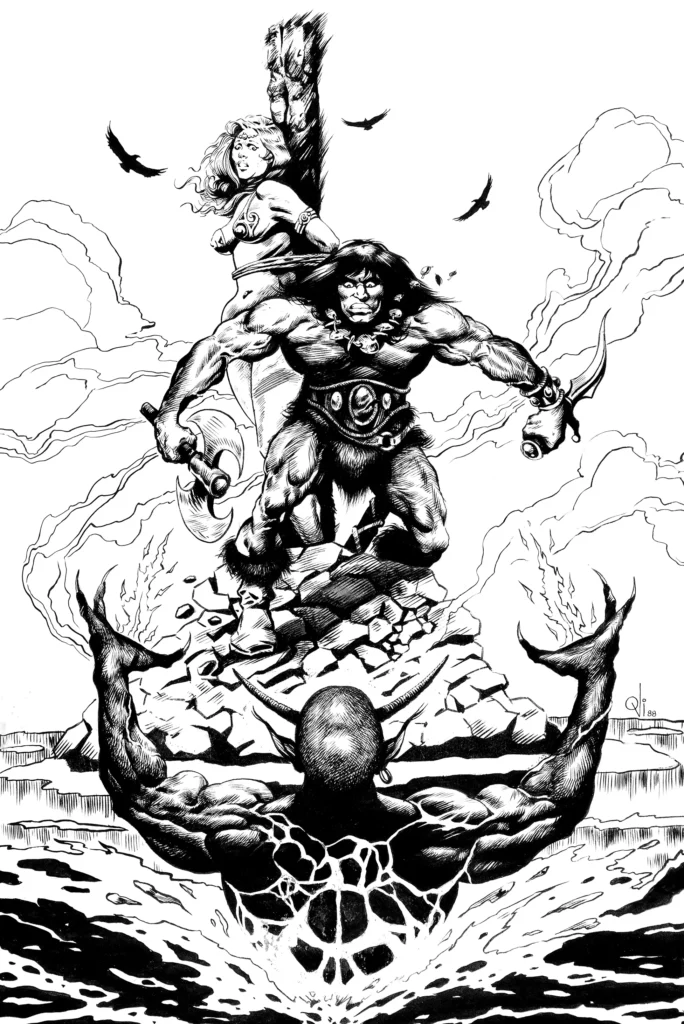
Illustrations, inspired by the Bath article, are all borrowed from Marvel’s Savage Sword of Conan magazine series. The header image is by Estaban Maroto.

Thanks for this one, Stu. Real interesting thoughts from these designers. Roads not taken are a thing. How different would the hobby have been if it had come out of Glorantha rather than the terminally medieval and Christian-inflected understand of fantasy that came out of Wisconsin?
And I hadn’t read your interview with Jenell Jaquays, so I’m heading there next.
There’s definitely a history of roleplaying games going back a fair way, even if they weren’t specifically fantasy+wargame+roleplaying. This site has a lot of useful information:
https://wobbupalooza.neocities.org/
I initially read about some of these pre-Braunstein RPGs via this piece (annoyingly framed in the context of ai):
https://aidungeon.medium.com/role-playing-games-in-the-renaissance-court-ab0bd680409a